Not just a physical need, but a ritual codified in gestures, symbols, and recipes. For centuries, food has transcended the sphere of mere sustenance, involving many other aspects of our everyday life. Gastronomic traditions, typical foods and recipes handed down from generation to generation tell us a lot about a place, the people who live there and their habits and customs. The relationship we establish with food is not linear, but depends on several different factors, including culture. In fact, none of us eats everything that is edible; religion, value systems and various socioeconomic motivations influence our choices in terms of food, as explained by anthropologist Marvin Harris through the lens of cultural materialism.
From Hands to Cutlery: The Evolution of the Art of Dining
But if “what” we eat says a lot about who we are and where we come from, “how” we eat is also an aspect that deserves some further investigation. It is well known that our ancestors ate with their hands, a custom that, in reality, has lasted much longer than we think. European nobles – even the Sun King under whose reign the Palace of Versailles was built – have long been detractors of the knife and fork. In some parts of the world, cutlery is still a rare tool, such as in Eritrea and Ethiopia where the famous zighinì, served on a large plate in the center of the table, is an open invitation to sharing and conviviality. In the West, however, the art of setting the table became a sort of mania starting from the 18th century, when even lunches and banquets represented opportunities for the aristocracy to confirm their status. When in the 19th century the transition was made from French-style service, which consisted of serving several courses at the same time like in a modern buffet, to Russian-style service, where the courses followed one after the other and were portioned by the servants, empty spaces began to form on the tables. In the Victorian era, to counter this horror vacui, tables throughout Europe reached their maximum splendor with eccentric centerpieces, silver candelabras, seasonal flowers, and fresh fruit, only to find a certain sobriety again during the 20th century.
Tablescaping: When the Art of Dining Becomes Design
Today this whimsical art form has finally found a name: tablescaping, a word that combines table and landscaping. Also known as table-setting, this discipline is particularly popular in the United States, where competitions involving porcelain and strict etiquette rules were organized as early as the 1930s. The objects that have graced our tables over the decades tell the story of our customs, time, and society. An example of this is the fork, imported into Europe from the East – where it was later abandoned in favor of chopsticks – and opposed by the Catholic Church, which claimed it encouraged lustful behavior. This object, along with the other two protagonists of cutlery – spoon and knife – was once strictly made of solid silver. Brands such as Bucellati (1919) and especially Christofle (1830) are among the custodians and promoters of this timeless style, handed down in the classic models of the French maison, first and foremost Marly (1897), famous for its botanical decorative motifs. Among the contemporary reinterpretations of Christofle’s baroque style is Jardin d’Eden, designed just over ten years ago by Dutch designer Marcel Wanders. Less than ten years after the bombast of Marly, Josef Hoffmann designed a cutlery service that completely overturned the paradigms of the art de la table of the time: in Rundes Modell (1906) formal elegance meets functionality, fully expressing the taste and research of the Wiener Werkstätte. In the early 2000s, Alessi re-proposed the collection in stainless steel, a material that over the course of the twentieth century took the place of the more expensive and oxidizable silver, as demonstrated, among others, by the Aj Cutlery service by Arne Jacobsen from 1957. Among the icons of Italian design are the Conca collection (1955) by Gio Ponti, characterized by an unexpected asymmetry that recalls that of the more recent Skeleton (2018) by Nendo – even more radical thanks to the removal of material where not strictly necessary -, and Moscardino (2000) by Matteo Ragni and Giulio Iacchetti which earned the two designers the Compasso d’Oro in 2001. Listed among the design pieces in the permanent exhibition of the MoMa in New York, it merges fork and spoon into a single biodegradable product designed for frugal meals or for the all-Italian ritual of the aperitivo.
Mise en Place: Tableware Between Tradition and Innovation
Between the knife and the fork, on tables all over the world, the plate is the other undisputed protagonist of the mise en place. Direct descendant of the bowl, over the centuries this object has lost its individual function in favor of a systemic structure in which each specimen has a different function based on its shape and size. Distinguished by the quality of the material and decoration, dinnerware comes with it a series of etiquette rules and behavioral norms with which good manners and belonging to a certain social class are identified. Typically made of ceramic, like the fork and knife, plates have also experienced a parable in aesthetic terms: initially very simple, they have become increasingly elaborate in accordance with the taste of high society, to then embrace the formal research of minimalism. In England, the pure classicism of porcelain is embodied by Wedgwood, one of the major European manufacturers founded in 1759 and the British alter ego of Richard Ginori – since 2020 only Ginori 1735. If the Antico Doccia line represents the deepest essence of Ginori’s ceramic art, the catalogue also features reinterpretations and more eccentric products signed by true design masters, from Gio Ponti – who returned on the topic of dinnerware several times in his career, as in the case of the collaboration with Ceramiche Franco Pozzi – to Luke Edward Hall. Of course, there are the plates inspired by the food and plant world, such the famous Cavolo Verde (1884) by Bordallo Pinheiro or the more recent Reversed Volumes (2013) by Mischer Traxler, but also sculptural collections such as La Boule (1971) by Villeroy & Boch whose design is a perfect fusion between aesthetics and practicality. Without forgetting the more daring experiments that abandoned ceramics in favor of plastic – Kartell first and foremost -, melamine – the material of choice for many Guzzini products – and glass, the protagonist of the project designed by Aino Aalto in 1932 for Pressed Glass 4644, gold medal at the 1936 Milan Triennale.
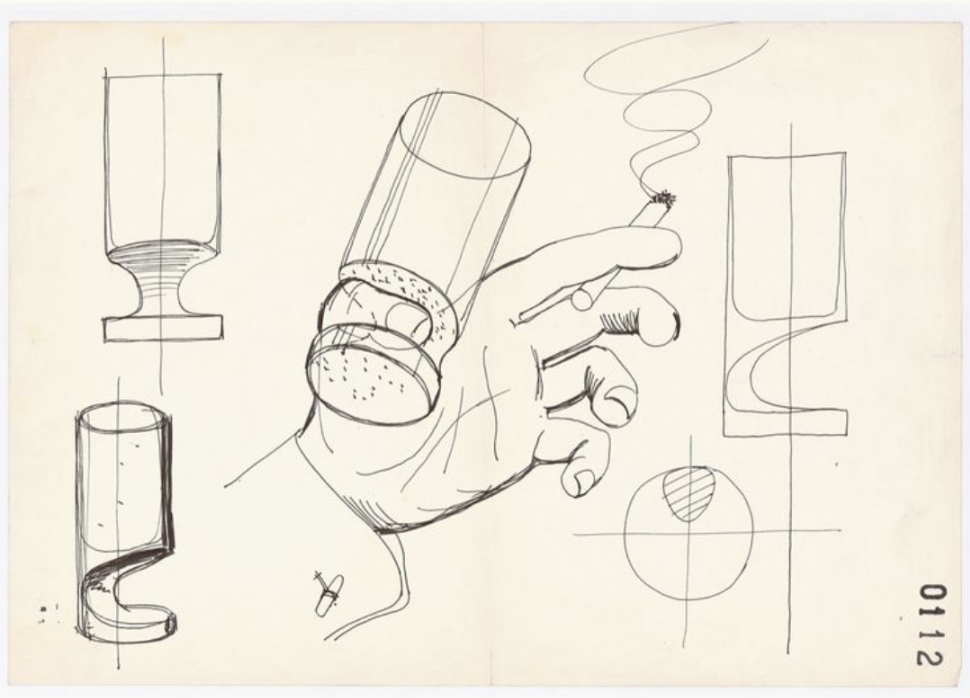
This review dedicated to the colorful world of tableware cannot be concluded without mentioning its third and final pillar, the glass, the one that perhaps more than any other allows designers and craftsmen to experiment with their imagination: goblets, mugs, tumblers, cups and so on and so forth. Already present on the tables of the Greeks, ancient Egyptians and Middle Eastern peoples of the 4th century BC, the glass is closely linked to the processing of a common material, glass, although over the centuries it has often been supplanted by the more precious Murano glass and crystal, but also by plastics and metals of various kinds. The 20th century has been the scene of ingenious experiments where design has never obscured the functional nature of the object. From the more convoluted Smoke (1964) by Joe Colombo and Paro (1983) by Achille Castiglioni, to the Ice Stopper by Angelo Mangiarotti (1986) and the colourful glasses designed by Mendini for Venini in the 1990s, up to the ironic Tri (2022) by Giulio Iacchetti.
In a world that is eager to find ever more surprising novelties, between daring gastronomic combinations and the advent of the so-called “foods of the future”, more nutritious and with a low environmental impact, we are already having a taste of the upcoming challenges in the field of industrial design. What new frontiers will designers explore in the near future?